

Constitution of the United States
The whole story … searchable, indexed version
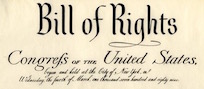
The First Ten Amendments to the Constitution
I. Freedom of Speech, Press, Religion, and Petition
Congress shall make no law respecting an establishment of religion, or prohibiting the free exercise thereof; or abridging the freedom of speech, or of the press; or the right of the people peaceably to assemble, and to petition the Government for a redress of grievances.
II. Right to keep and bear arms
A well-regulated militia, being necessary to the security of a free State, the right of the people to keep and bear arms, shall not be infringed.
III. Conditions for quarters of soldiers
No soldier shall, in time of peace be quartered in any house, without the consent of the owner, nor in time of war, but in a manner to be prescribed by law.
IV. Right of search and seizure regulated
The right of the people to be secure in their persons, houses, papers, and effects, against unreasonable searches and seizures, shall not be violated, and no warrants shall issue, but upon probable cause, supported by oath or affirmation, and particularly describing the place to be searched, and the persons or things to be seized.
V. Provisions concerning prosecution
No person shall be held to answer for a capital, or otherwise infamous crime, unless on a presentment or indictment of a Grand Jury, except in cases arising in the land or naval forces, or in the militia, when in actual service in time of war or public danger; nor shall any person be subject for the same offense to be twice put in jeopardy of life or limb; nor shall be compelled in any criminal case to be a witness against himself, nor be deprived of life, liberty, or property, without due process of law; nor shall private property be taken for public use without just compensation.
VI. Right to a speedy trial, witnesses, etc.
In all criminal prosecutions, the accused shall enjoy the right to a speedy and public trial, by an impartial jury of the State and district wherein the crime shall have been committed, which district shall have been previously ascertained by law, and to be informed of the nature and cause of the accusation; to be confronted with the witnesses against him; to have compulsory process for obtaining witnesses in his favor, and to have the assistance of counsel for his defense.
VII. Right to a trial by jury
In suits at common law, where the value in controversy shall exceed twenty dollars, the right of trial by jury shall be preserved, and no fact tried by a jury shall be otherwise reexamined in any court of the United States, than according to the rules of the common law.
VIII. Excessive bail, cruel punishment
Excessive bail shall not be required, nor excessive fines imposed, nor cruel and unusual punishments inflicted.
IX. Rule of construction of Constitution
The enumeration in the Constitution, of certain rights, shall not be construed to deny or disparage others retained by the people.
X. Rights of the states under constitution
The powers not delegated to the United States by the Constitution, nor prohibited by it to the States, are reserved to the States respectively, or to the people.

Find Law is chock full of basics. Below are a few excerpts and links to a lot more.
http://civilrights.findlaw.com/civil-rights-overview.html
http://civilrights.findlaw.com/civil-rights-overview/civil-rights-basics.html
What Are Civil Rights?
Civil rights are the rights of individuals to receive equal treatment (and to be free from unfair treatment or “discrimination”) in a number of settings — including education, employment, housing, and more — and are based on certain legally protected characteristics.
Historically, the Civil Rights Movement referred to efforts toward achieving true equality for African Americans in all facets of society, but today the term “civil rights” is also used to describe the advancement of equality for all people regardless of race, sex, age, disability, national origin, religion, or certain other characteristics.
Where Do Civil Rights Come From?
Most laws guaranteeing and regulating civil rights originate at the federal level, either through federal legislation, or through federal court decisions (such as those handed down by the U.S. Supreme Court). States also pass their own civil rights laws (usually very similar to those at the federal level), and even municipalities like cities and counties can enact ordinances and laws related to civil rights.
Learn More About Where Civil Rights Come From
“Civil Rights” vs. “Civil Liberties”
It is important to note the difference between “civil rights” and “civil liberties.” The legal area known as “civil rights” has traditionally revolved around the basic right to be free from unequal treatment based on certain protected characteristics (race, gender, disability, etc.) in settings such as employment and housing. “Civil liberties” concern basic rights and freedoms that are guaranteed — either explicitly identified in the Bill of Rights and the Constitution, or interpreted through the years by courts and lawmakers. Civil liberties include:
- Freedom of speech
- The right to privacy
- The right to be free from unreasonable searches of your home
- The right to a fair court trial
- The right to marry
- The right to vote
One way to consider the difference between “civil rights” and “civil liberties” is to look at (1) what right is affected, and (2) whose right is affected. For example, as an employee, you do not have the legal right to a promotion, mainly because getting a promotion is not a guaranteed “civil liberty.” But, as a female employee, you do have the legal right to be free from discrimination in being considered for that promotion — you cannot legally be denied the promotion based on your gender (or race, or disability, etc.). By choosing not to promote a female worker solely because of the employee’s gender, the employer has committed a civil rights violation and has engaged in unlawful employment discrimination based on sex or gender.
Specific Types of Civil Liberties
“Civil liberties” typically include basic rights and freedoms that are guaranteed by law—either explicitly identified in laws and constitutions, or interpreted through the years by courts and lawmakers. While civil rights are those rights or powers that individuals may exercise under civil law (such as the from discrimination based on one’s skin color or gender), civil liberties are freedoms that provide individuals limited protection from the government (such as freedom of the press or the right to assemble).
In the U.S., certain civil liberties are guaranteed by the Constitution. However, some states provide broader protection of individuals’ civil liberties than do others. For instance, California law prohibits discrimination on the basis of sexual orientation in employment, housing, and education. In many other states, however, LGBT employees may be terminated on the basis of their sexual orientation.
excerpted from FindLaw
 LNL
LNL 