
History, New Perspectives, Contemporary Challenges
History
New Perspectives
Contemporary Challenges
History …
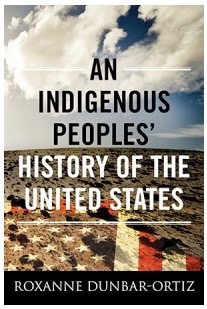
Today in the United States, there are more than five hundred federally recognized Indigenous nations comprising nearly three million people, descendants of the fifteen million Native people who once inhabited this land. The centuries-long genocidal program of the US settler-colonial regimen has largely been omitted from history. Acclaimed historian and activist Roxanne Dunbar-Ortiz offers a history of the United States told from the perspective of Indigenous peoples and reveals how Native Americans, for centuries, actively resisted expansion of the U.S. empire.
In An Indigenous Peoples’ History of the United States, Dunbar-Ortiz adroitly challenges the founding myth of the United States and shows how policy against the Indigenous peoples was colonialist and designed to seize the territories of the original inhabitants, displacing or eliminating them. And as Dunbar-Ortiz reveals, this policy was praised in popular culture, through writers like James Fenimore Cooper and Walt Whitman, and in the highest offices of government and the military. Shockingly, as the genocidal policy reached its zenith under President Andrew Jackson, its ruthlessness was best articulated by US Army general Thomas S. Jesup, who, in 1836, wrote of the Seminoles: “The country can be rid of them only by exterminating them.”
Publisher’s description.
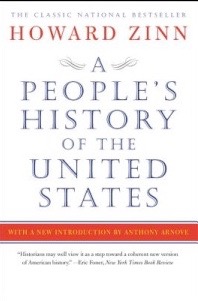

Since its original landmark publication in 1980, A People’s History of the United States has been chronicling American history from the bottom up.
Known for its lively, clear prose as well as its scholarly research, A People’s History is the only volume to tell America’s story from the point of view of—and in the words of—America’s women, factory workers, African-Americans, Native Americans, the working poor, and immigrant laborers. As historian Howard Zinn shows, many of our country’s greatest battles—the fights for a fair wage, an eight-hour workday, child-labor laws, health and safety standards, universal suffrage, women’s rights, racial equality—were carried out at the grassroots level, against bloody resistance. Covering Christopher Columbus’s arrival through President Clinton’s first term, A People’s History of the United States features insightful analysis of the most important events in our history.
Library Journal calls Howard Zinn’s iconic A People’s History of the United States “a brilliant and moving history of the American people from the point of view of those. . . whose plight has been largely omitted from most histories.” Packed with vivid details and telling quotations, Zinn’s award-winning classic continues to revolutionize the way American history is taught and remembered.
And for young people:
Now in paperback with illustrations, this is the new, revised, and updated single volume young adult edition of Howard Zinn’s classic telling of American history. A Young People’s History of the United States by Howard Zinn with Rebecca Stefoff brings to U.S. history the viewpoints of workers, people who are enslaved, immigrants, women, Native Americans, and others whose stories, and their impact, are rarely included in books for young people.
Beginning with a look at Christopher Columbus’ arrival through the eyes of the Arawak Indians; then leading the reader through the struggles for workers’ rights, women’s rights, and civil rights during the nineteenth and twentieth centuries; and ending with the current protests against continued American imperialism, Zinn presents a radical new way of understanding America’s history. In so doing, he reminds readers that America’s true greatness is shaped by our dissident voices, not our military generals.
Publisher’s description.
New Perspectives …

Today’s world is not the one we want—climate change, financial collapse, poverty, and war leave many feeling overwhelmed and hopeless.
YES! Magazine empowers people with the vision and tools to create a healthy planet and vibrant communities. We do this by:
- Reframing issues and outlining a path forward;
- Giving a voice to the people who are making change;
- Offering resources to use and pass along
We publish all of our stories under the Creative Commons license, and encourage you to make free use of our articles by taking these easy steps.
Yes! is a non-profit supported by our readers. The magazine is completely ad free so advertisers cannot influence the content. YES! Magazine is printed on 100% post-consumer waste, chlorine-free paper. We reach more than 150,000 readers quarterly. More than 350,000 people visit our website each month, where we post new stories every day.
Yes! Magazine is one of the most positive and practical periodicals available today. It draws ideas, information, vision, insight, actions, solutions and more from real people all over the world doing practical, grass roots work. I read it regularly - and especially if things begin to look hopeless. Yes! consistently provides Hope & Inspiration.

Last year, founder and editor-at-large (of YES! Magazine) Sarah van Gelder set out on an 18-state road trip to see for herself what communities were up against and how they were rising to the challenge. She found a revolution of sorts—on the ground, in our neighborhoods, so widespread that people didn’t always recognize what they were a part of. Women of North Dakota’s Turtle Mountain reservation who, after witnessing the devastation oil extraction wrought on a neighboring reservation, banned fracking in their own community. Worker-owners of a Chicago factory who occupied and then bought the business cooperatively when previous owners tried to shut it down. “The revolution I discovered is decentralized, not flashy, includes everyone, especially those now excluded from wealth and power,” she concluded in her upcoming book, The Revolution Where You Live: Stories from a 12,000-mile Journey Through a New America. “Only where we live, in our neighborhoods and cities and towns where we encounter each other and can know each other, can the transformation be deep enough.”
Excerpted from YES! Magazine
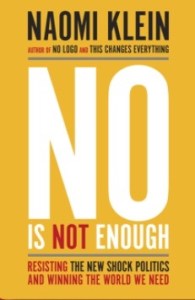
No Is Not Enough
by Naomi Klein
“This book is a toolkit to help understand how we arrived at this surreal political moment, how to keep it from getting a lot worse, and how, if we keep our heads, we can flip the script and seize the opportunity to make things a whole lot better in a time of urgent need. A toolkit for shock-resistance.” Naomi Klein, from the Introduction
The election of Donald Trump is a dangerous escalation in a world of cascading crises. Trump’s vision–a radical deregulation of the U.S. economy in the interest of corporations, an all-out war on “radical Islamic terrorism,” and a sweeping aside of climate science to unleash a domestic fossil fuel frenzy–will generate wave after wave of crises and shocks, to the economy, to national security, to the environment.
In No Is Not Enough, Naomi Klein explains that Trump, extreme as he is, is not an aberration but a logical extension of the worst and most dangerous trends of the past half-century. In exposing the malignant forces behind Trump’s rise, she puts forward a bold vision for a mass movement to counter rising militarism, nationalism, and corporatism in the U.S. and around the world.
Naomi Klein is an award-winning journalist, syndicated columnist and author of the international bestsellers No Logo, The Shock Doctrine, and most recently This Changes Everything: Capitalism vs. the Climate. In 2017 she joined The Intercept as Senior Correspondent.
Below is a link to a full interview by Amy Goodman/Juan Gonzalez with Naomi Klein on Democracry Now! about her new book.
Democracy Now!Amy Goodman/Juan Gonzalez: Interview Naomi Klein
Contemporary Challenges …

On Tyranny: Twenty Lessons from the Twentieth Century
by Timothy Snyder
http://timothysnyder.org/books/on-tyranny-tr
“The Founding Fathers tried to protect us from the threat they knew, the tyranny that overcame ancient democracy. Today, our political order faces new threats, not unlike the totalitarianism of the twentieth century. We are no wiser than the Europeans who saw democracy yield to fascism, Nazism, or communism. Our one advantage is that we might learn from their experience.”
Snyder presents 20 lessons we might learn from those times and how we might apply them to our current situation. Below is a very brief listing of these 20 lessons … followed by two interviews with the author: one from Democracy Now! and one from NPR.
1. Do not obey in advance. Much of the power of authoritarianism is freely given. In times like these, individuals think ahead about what a more repressive government will want, and then start to do it without being asked. You’ve already done this, haven’t you? Stop. Anticipatory obedience teaches authorities what is possible and accelerates unfreedom.
2. Defend an institution. Follow the courts or the media, or a court or a newspaper. Do not speak of “our institutions” unless you are making them yours by acting on their behalf. Institutions don’t protect themselves. They go down like dominoes unless each is defended from the beginning.
3. Recall professional ethics. When the leaders of state set a negative example, professional commitments to just practice become much more important. It is hard to break a rule-of-law state without lawyers, and it is hard to have show trials without judges.
4. When listening to politicians, distinguish certain words. Look out for the expansive use of “terrorism” and “extremism.” Be alive to the fatal notions of “exception” and “emergency.” Be angry about the treacherous use of patriotic vocabulary.
5. Be calm when the unthinkable arrives. When the terrorist attack comes, remember that all authoritarians at all times either await or plan such events in order to consolidate power. Think of the Reichstag fire. The sudden disaster that requires the end of the balance of power, the end of opposition parties, and so on, is the oldest trick in the Hitlerian book. Don’t fall for it.
6. Be kind to our language. Avoid pronouncing the phrases everyone else does. Think up your own way of speaking, even if only to convey that thing you think everyone is saying. (Don’t use the internet before bed. Charge your gadgets away from your bedroom, and read.) What to read? Perhaps “The Power of the Powerless” by Václav Havel, 1984 by George Orwell, The Captive Mind by Czesław Milosz, The Rebel by Albert Camus, The Origins of Totalitarianism by Hannah Arendt, or Nothing is True and Everything is Possible by Peter Pomerantsev.
7. Stand out. Someone has to. It is easy, in words and deeds, to follow along. It can feel strange to do or say something different. But without that unease, there is no freedom. And the moment you set an example, the spell of the status quo is broken, and others will follow.
8. Believe in truth. To abandon facts is to abandon freedom. If nothing is true, then no one can criticize power, because there is no basis upon which to do so. If nothing is true, then all is spectacle. The biggest wallet pays for the most blinding lights.
9. Investigate. Figure things out for yourself. Spend more time with long articles. Subsidize investigative journalism by subscribing to print media. Realize that some of what is on your screen is there to harm you. Learn about sites that investigate foreign propaganda pushes.
10. Practice corporeal politics. Power wants your body softening in your chair and your emotions dissipating on the screen. Get outside. Put your body in unfamiliar places with unfamiliar people. Make new friends and march with them.
11. Make eye contact and small talk. This is not just polite. It is a way to stay in touch with your surroundings, break down unnecessary social barriers, and come to understand whom you should and should not trust. If we enter a culture of denunciation, you will want to know the psychological landscape of your daily life.
12. Take responsibility for the face of the world. Notice the swastikas and the other signs of hate. Do not look away and do not get used to them. Remove them yourself and set an example for others to do so.
13. Hinder the one-party state. The parties that took over states were once something else. They exploited a historical moment to make political life impossible for their rivals. Vote in local and state elections while you can.
14. Give regularly to good causes, if you can. Pick a charity and set up autopay. Then you will know that you have made a free choice that is supporting civil society helping others doing something good.
15. Establish a private life. Nastier rulers will use what they know about you to push you around. Scrub your computer of malware. Remember that email is skywriting. Consider using alternative forms of the internet, or simply using it less. Have personal exchanges in person. For the same reason, resolve any legal trouble. Authoritarianism works as a blackmail state, looking for the hook on which to hang you. Try not to have too many hooks.
16. Learn from others in other countries. Keep up your friendships abroad, or make new friends abroad. The present difficulties here are an element of a general trend. And no country is going to find a solution by itself. Make sure you and your family have passports.
17. Watch out for the paramilitaries. When the men with guns who have always claimed to be against the system start wearing uniforms and marching around with torches and pictures of a Leader, the end is nigh. When the pro-Leader paramilitary and the official police and military intermingle, the game is over.
18. Be reflective if you must be armed. If you carry a weapon in public service, God bless you and keep you. But know that evils of the past involved policemen and soldiers finding themselves, one day, doing irregular things. Be ready to say no. (If you do not know what this means, contact the United States Holocaust Memorial Museum and ask about training in professional ethics.)
19. Be as courageous as you can. If none of us is prepared to die for freedom, then all of us will die in unfreedom.
20. Be a patriot. The incoming president is not. Set a good example of what America means for the generations to come. They will need it.
Democracy Now!’s Amy Goodman & Juan Gonzalez: Yale Historian Timothy Snyder on How the U.S. Can Avoid Sliding into Authoritarianism
Democracy Now!:Timothy Snyder with Amy Goodman/Juan Gonzalez
NPR’s Robert Siegel talks with historian Timothy Snyder which explores the new threats faced by our political order and how we can look back to the 20th century for lessons on how to overcome them:
Audio Player
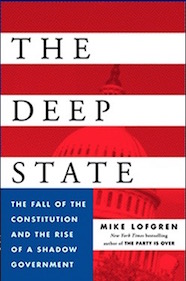
The Deep State
The Fall of the Constitution and the Rise of a Shadow Government
by Mike Lofgren
An excerpt from the introduction ... important in understanding what we are up against in our efforts to create a a true Democracy in the USA.
http://www.mikelofgren.net/introduction-to-the-deep-state/
Anyone who has spent time on Capitol Hill will occasionally get the feeling when watching debates in the House or Senate chambers that he or she is seeing a kind of marionette theater, with members of Congress reading carefully vetted talking points about prefabricated issues. This impression was particularly strong both in the run-up to the Iraq war and later, during the mock deliberations over funding that ongoing debacle. While the public is now aware of the disproportionate influence of powerful corporations over Washington, best exemplified by the judicial travesty known as the Citizens United decision, few fully appreciate that the United States has in the last several decades gradually undergone a process first identified by Aristotle and later championed by Machiavelli that the journalist Lawrence Peter Garrett described in the 1930s as a “revolution within the form.” Our venerable institutions of government have outwardly remained the same, but they have grown more and more resistant to the popular will as they have become hardwired into a corporate and private influence network with almost unlimited cash to enforce its will.
Even as commentators decry a broken government that cannot marshal the money, the will, or the competence to repair our roads and bridges, heal our war veterans, or even roll out a health care website, there is always enough money and will, and maybe just enough competence, to overthrow foreign governments, fight the longest war in U.S. history, and conduct dragnet surveillance over the entire surface of the planet.
This paradox of penury and dysfunction on the one hand and unlimited wealth and seeming omnipotence on the other is replicated outside of government as well. By every international metric of health and living standards, the rural countries of southern West Virginia and eastern Kentucky qualify as third world. So do large areas of Detroit, Cleveland, Camden, Gary, and many other American cities. At the same time, wealth beyond computation, almost beyond imagining, piles up in the money center of New York and the technology hub of Palo Alto. It piles up long enough to purchase a $95,000 truffle, a $38 million vintage Ferrari GTO, or a $179 million Picasso before the balance finds its way to an offshore hiding place.
These paradoxes, both within the government and within the ostensibly private economy, are related. They are symptoms of a shadow government ruling the United States that pays little heed to the plain words of the Constitution. Its governing philosophy profoundly influences foreign and national security policy and such domestic matters as spending priorities, trade, investment, income inequality, privatization of government services, media presentation of news, and the whole meaning and worth of citizens’ participation in their government.
I have come to call this shadow government the Deep State. The term was actually coined in Turkey, and is said to be a system composed of high-level elements within the intelligence services, military, security, judiciary, and organized crime. In John le Carré’s recent novel, A Delicate Truth, a character in the book describes the Deep State as “the ever-expanding circle of non-governmental insiders from banking, industry and commerce who were cleared for highly classified information denied to large swathes of Whitehall and Westminster.” I use the term to mean a hybrid association of key elements of government and parts of top-level finance and industry that is effectively able to govern the United States with only limited reference to the consent of the governed as normally expressed through elections.
The Deep State is the big story of our time. It is the red thread that runs through the war on terrorism and the militarization of foreign policy, the financialization and deindustrialization of the American economy, the rise of a plutocratic social structure that has given us the most unequal society in almost a century, and the political dysfunction that has paralyzed day-to-day governance.
Edward Snowden’s June 2013 exposure of the pervasiveness of the National Security Agency’s surveillance has partially awakened a Congress that was asleep at the switch and ignited a national debate about who is really in charge of our government. At the same time, a few politicians, most notably Elizabeth Warren of Massachusetts, are beginning to argue that the American economy is rigged. But these isolated cases have not provided a framework for understanding the extent of the shadow government, how it arose, the interactions of its various parts, and the extent to which it influences and controls the leaders whom we think we choose in elections. This book, based in large part on my experiences and observations while in public service, aims to provide that framework.
My reflection on our shadow system of government has come only after my retirement in 2011 and my physical withdrawal from Washington, D.C. proper and the institutions located there. Unlike the vast majority of Capitol Hill strivers who leave the place for greener pastures, I had no desire to join a lobbying shop, trade association, think tank, or consultancy. But I did have a need to see the events I had witnessed in perspective, and I came to realize that the nation’s capital, where I lived and worked for more than half my lifetime, has its own peculiar ecology.
To look upon Washington once again with fresh eyes, I sometimes feel as Darwin must have when he first set foot on the Galapagos Islands. From the Pentagon to K Street, and from the contractor cube farms in Crystal City to the public policy foundations along Massachusetts Avenue, the terrain and its people are exotic and well worth examining in a scientific manner. The official United States government has its capital there, and so does our state within a state. To describe them in the language of physics, they coexist in the same way it is possible for two subatomic particles to coexist in an entangled quantum state. The characteristics of each particle, or each governmental structure, cannot fully be described independently; instead, we must find a way to describe the system as a whole.
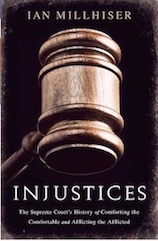
Injustices
The Supreme Court’s History of Comforting the Comfortable and Afflicting the Afflicted
by Ian Millhauser
Few American institutions have inflicted greater suffering on ordinary people than the Supreme Court of the United States. Since its inception, the justices of the Supreme Court have shaped a nation where children toiled in coal mines, where Americans could be forced into camps because of their race, and where a woman could be sterilized against her will by state law. The Court was the midwife of Jim Crow, the right hand of union busters, and the dead hand of the Confederacy. Nor is the modern Court a vast improvement, with its incursions on voting rights and its willingness to place elections for sale.
In this powerful indictment of a venerated institution, Ian Millhiser tells the history of the Supreme Court through the eyes of the everyday people who have suffered the most from it. America ratified three constitutional amendments to provide equal rights to freed slaves, but the justices spent thirty years largely dismantling these amendments. Then they spent the next forty years rewriting them into a shield for the wealthy and the powerful. In the Warren era and the few years following it, progressive justices restored the Constitution’s promises of equality, free speech, and fair justice for the accused. But, Millhiser contends, that was an historic accident. Indeed, if it weren’t for several unpredictable events, Brown v. Board of Education could have gone the other way.
In Injustices, Millhiser argues that the Supreme Court has seized power for itself that rightfully belongs to the people’s elected representatives, and has bent the arc of American history away from justice.
Excerpted from: http://www.indiebound.org A Community of Independent Local Bookstores
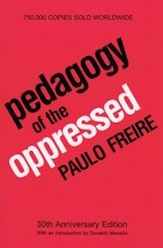
Pedagogy of the Oppressed
by Paulo Friere
First published in Portuguese in 1968, Pedagogy of the Oppressed was translated and published in English in 1970. The methodology of the late Paulo Freire has helped to empower countless impoverished and illiterate people throughout the world. Freire’s work has taken on especial urgency in the United States and Western Europe, where the creation of a permanent underclass among the underprivileged and minorities in cities and urban centers is increasingly accepted as the norm.
The justification for a pedagogy of the oppressed; the contradiction between the oppressors and the oppressed, and how it is overcome; oppression and the oppressors; oppression and the oppressed; liberation: not a gift, not a self-achievement, but a mutual process.
The “banking” concept of education as an instrument of oppression-its presuppositions-a critique; the problem-posing concept of education as an instrument for liberation-its presuppositions; the “banking” concept and the teacher-student contradiction; the problem-posting concept and the supersedence of the teacher-student contradiction; education: a mutual process, world-mediated; people as uncompleted beings, conscious of their incompletion, and their attempt to be more fully human.
Dialogics-the essence of education as the practice of freedom; dialogics and dialogue; dialogue and the search for program content; the human-world relationship, “generative themes,” and the program content of education as the practice of freedom; the investigation of “generative themes” and its methodology; the awakening of critical consciousness through investigation of “generative themes”; the various stages of the investigation.
Antidialogics and dialogics as matrices of opposing theories of cultural action: the former as an instrument of oppression and the latter as an instrument of liberation; the theory of antidialogical action and its characteristics: conquest, divide and rule, manipulation, and cultural invasion; the theory of dialogical action and its characteristics: cooperation, unity, organization, and cultural synthesis.
Excerpted from: to see more: http://www.bloomsbury.com/us/pedagogy-of-the-oppressed-9780826412768/#sthash.2M1J7ZRe.dpuf
For excerpt and bio of Paulo Friere: https://zinnedproject.org/materials/pedagogy-of-the-oppressed/

Unconstitutional
The War On Our Civil Liberties
Film. By Nonny de la Peña. 2004. 69 min.
A documentary that investigates the ways in which the civil liberties of U.S. citizens and immigrants have been rolled back since 9/11/2001 and the passage of the Patriot Act.
In the wake of the terrorist attacks of September 11, 2001, the United States Congress passed what became known as “The Patriot Act,” a package of legislation President George W. Bush and his cabinet claimed was intended to help law enforcement officials take steps to stop terrorism. However, the bill was run through Congress so quickly that very few lawmakers were able to read it before it was passed, and it wasn’t long before many Americans began to ask if the act posed a real threat to civil liberties and constitutional freedoms at home.
Unconstitutional: The War on Our Civil Liberties is a documentary that takes a close look at the Patriot Act, offers opinions from legal and constitutional scholars about its possible dangers, and features interviews with law-abiding citizens who’ve run afoul of the broad interpretations and implications of its regulations. (Review by Mark Deming, Rovi; Zinn History Project).
 LNL
LNL 