Democracy in the USA Today
Democracy Old & New
Preamble: a clause at the beginning of a constitution or statute that explains the reasons for its passage.
If we sincerely wish to create a truer and more evolved Democracy than anything yet seen in our country — or even in our world — it might be wise to first ask ourselves what we need in order to accomplish this. What does this entail? what does this mean both practically and philosophically?
Questions … more than answers can promote exploration, research, openness, creativity, etc. Following are some beginning questions, diverse points of view, various experiments & explorations happening in our world, to encourage thinking, dreaming, visioning, understanding. … Openness to the beauty of diverse cultures and ideas, and a willingness to allow for their integration and synergy both inside and outside ourselves creates the fertile ground from which something brand new can come into being.
What questions can you think of?
- What is Democracy?
- What is our current form of Democracy? What are its gifts? what are its problems?
- What is currently threatening our Democracy? What strengthens and protects a Democracy from corruption and destruction?
- What are other forms of government? Are there forms of government do we not wish to encourage? Why? Can different forms of governments be integrated to create ever evolving governments?
- What do we need to cultivate personally and as communities to participate? What role does ethics, integrity, trustworthiness play? Money? How does citizen education effect Democracy? What stands in our way internally? externally?
- How does something new come into being? How can a non-violent change/evolution of government take place?
Democracy in the USA Today

Preamble to the Constitution of the United States
“We the people of the United States, in order to form a more perfect Union, establish Justice, insure domestic Tranquility, provide for the common defense, promote the general Welfare, and secure the Blessings of Liberty to ourselves and our Posterity, do ordain and establish this Constitution of the United States of America.”
The Constitution: Basic architecture — the whole story — searchable, indexed version: http://constitutionus.com/
Representative Democracy (Republic)
The USA is primarily a Representative Democracy (Republic). Representative Democracy entails electing individuals to represent the people. Here, people allow representatives to form an independent ruling body (i.e., Congress) to represent them in the various democratic processes. The people are not directly involved in any of the processes of legislation or lawmaking. This form of democracy is found at the federal level of the US, and the branches of government in the US act on behalf of the people. This form depends upon the ability of the people to make their wishes known to their representatives and the integrity of the representatives to act according to the wishes of the people who elected them.
Participatory or Direct Democracy
Secondarily, we have opportunities for Participatory or Direct Democracy. Individual participation by citizens in political decisions and policies that affect their lives, directly rather than through elected representatives. Example: Ballot Initiatives placed up for a vote by citizen petitions and then voted on by the specific population affected (i.e., banning GMO cultivation in certain agricultural regions).
Grassroots Democracy
Designing political processes where as much decision-making authority as practical is shifted to the organization’s lowest geographic or social level of organization.
Grassroots organizations can have a variety of structures; depending on the type of organization and what the members want. These can be non-structured and non-hierarchical organizations that are run by all members, or by whichever member wishes to do something.
To cite a specific hypothetical example, a national grassroots organization would place as much decision-making power as possible in the hands of local chapters or common members instead of the head office. The principle is that for democratic power to be best exercised it must be vested in a local community and common members and instead of isolated, atomized individuals, at the top of the organization. Grassroots organizations can inhabit participatory systems. Grassroots systems differ from representative systems that allow local communities or national memberships to elect representatives who then go on to make decisions.
The difference between the three systems comes down to where they rest on two different axes: the rootedness in a community (grassroots versus national or international) and the ability of all individuals to participate in the shared decision-making process (participatory versus representative).
excerpted from: https://en.wikipedia.org/wiki/Grassroots_democracy
Democratic Socialism
Democratic socialism is defined as having a socialist economy in which the means of production are socially and collectively owned or controlled alongside a politically democratic system of government. It is the active participation of the population as a whole, and workers in particular, in the management of the economy that characterizes democratic socialism.
Democracy Old & New
Haudenosaunee (Iroquois) Confederacy
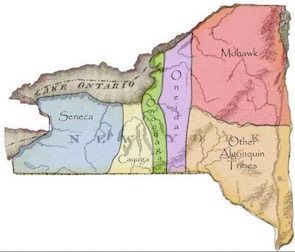
The Haudenosaunee Confederacy created the first Democracy in what is now known as New York State in the USA. They were here long, long, long before Europeans came. Their democracy was “discovered” by Benjamin Franklin who contributed their ideas during the formation of our government. But there is a great deal more than Franklin shared and the Founding Fathers incorporated for us to consider.
Representative Democracy of the Haudenosaunee
A confederacy formed of 5 tribes: Mohawk, Oneida, Seneca, Onondaga, Cayuga
Great Law of Peace
Simply put. the Great Law of Peace is the founding constitution of the Haudenosaunee Confederacy and is the underlying basis for Haudenosaunee society. Originally it outlined the path to harmony and unity among the warring nations and set out a proper form of government which allowed for the ideas of peace, power, and righteousness.
Throughout its verses it explains the function of the Grand Council and outlines a plan for nations to resolve disputes and uphold the peace. It outlines all processes which may face the Haudenosaunee as explained by the Peacemaker. Leadership within the system is from the ground up making the leaders truly accountable to their people. It outlines the responsibilities of all Chiefs as well as the method of impeachment in the event that a Chief does not perform his duties to the satisfaction of his people.
Within the text it also highlights many of the symbols of the Haudenosaunee including the Great Tree of Peace. As a symbol of peace, all the Chiefs stand around the tree in a circle, arms linked, to support it and prevent it from falling over. Atop the tree sits an eagle to see far and wide and warn of danger.
Because Haudenosaunee history is an oral history there have been many versions of the Great Law written. It is shared from generation to generation through oral tradition using a series of wampum belts, held by the Confederacy, to help to share the story. No one version of the Great Law is preferred over another as all the same themes still exist to emphasize its main principles.
Outlined in the Great Law, also known as Gayanashagowa or The Great Binding Law, are many of the teachings provided by the Peacemaker. Within the text are three main principles which stand out to govern the rest: peace, power, and righteousness. Each principle depends on the other to support the framework of the constitution. The peace element signifies ones own peace and being of a good mind and the ability to use our minds to negotiate rather than going to war. In order to have peace one must have balance in their life with health of mind and body. This peace allows one the good mind needed for the next principle, power.
Again power does not necessarily mean having power over another. Among the Haudenosaunee, power comes from unity, for there is strength in numbers. Living a family-based existence with unity at its core, the power comes from the unity of each nation into a family. Like the symbol of the five arrows bound together, singularly we are easily broken but together we are unbreakable. Being of a good mind one is able to use reason in their decisions and respect this power.
The Haudenosaunee believe that the Creator has for us all a life path and a responsibility. It is by achieving these goals outlined for us that we gain the final principle of righteousness. Righteousness is found through living a proper life and following the will of the Creator as set out in the original instructions.
The main idea is that peace is the overall will of the Creator and using the tools of peace, power, and righteousness it can be attained.
From: http://haudenosaunee.ca/5.html
Below is one of the unique features of their Democracy — a feature sorely lacking from our own; not just inclusion of women, but an honored and empowered role.
“Certain female lineages controlled the choice of male representatives for their clans in governing councils. Men were the representatives, but the women who chose them had the right to speak in the council, and when the chosen male representative was too young or inexperienced to be effective, one of the women might participate in the council on his behalf. Clan mother had the power to recall unsatisfactory representatives.”
From: “All the Real Indians Died Off” and 20 Other Myths About Native Americans by Roxanne Dunbar-Ortiz and Dian Gilio-WHitaker

Earth Democracy
Earth Democracy is a beautiful, creative contribution from India, founded by Dr. Vandana Shiva. Intrinsic to this vision is a Democracy that includes all life forms and all people — Earth Democracy. Many successful projects have been created based on this vision. For a full-throated look, check out the website. Below is a brief look at the principles.
Navdanya means “nine seeds” (symbolizing protection of biological and cultural diversity) and also the “new gift” (for seed as commons, based on the right to save and share seeds. In today’s context of biological and ecological destruction, seed savers are the true givers of seed. This gift or “dana” of Navadhanyas (nine seeds) is the ultimate gift — it is a gift of life, of heritage and continuity. Conserving seed is conserving biodiversity, conserving knowledge of the seed and its utilization, conserving culture, conserving sustainability.
Principles of Earth Democracy
The participation of all peoples and species in the common welfare of all.
- All species, peoples, and cultures have intrinsic worth.
- The earth community is a democracy of all life.
- Diversity in nature and culture must be defended.
- All beings have a natural right to sustenance.
- Earth Democracy is based on living economies and economic democracy.
- Living economies are built on local economies.
- Earth Democracy is a living democracy.
- Earth Democracy is based on living cultures.
- Living cultures are life nourishing.
- Earth Democracy globalizes peace, care, and compassion.
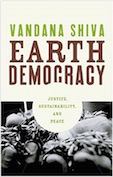
For a more complete understanding, please check out:
Earth Democracy
by Vendana Shiva; South End Press
All above excerpted from Navdanya

http://www.wisedemocracy.org/index.html
Nourishing food for thought. Highly recommend a look at the site. Deep explanations with videos and accounts from real experiences. Very creative and grounded in the real world.
An excellent effort to evolve our current system without leaving the Constitution or its foundation. Rather it is the development of what they call Wisdom Councils. A practical strategy promising to facilitate an inclusive powerful symbolic voice of “We the People.” It is based on new practices, experiments and theory developed in the US. The key practices of this approach are being prototyped in Europe, particularly in Vorarlberg, Austria, where elected leaders have modified their state constitution to include these methods.
http://www.wisedemocracy.org/page35/page32/our_history.html
In 1990, Jim Rough began teaching seminars on “Dynamic Facilitation,” a way for people to face difficult issues, be creative together, and come together in unity through shifts and breakthroughs. The following story summarizes our journey, including 12 “breakthroughs,” so far. Also included are examples of natural reactions against each breakthrough, what is described as a “heresy alert!”
In the seminars, participants practice Dynamic Facilitation in small groups. Often, groups worked to solve impossible-seeming issues from society, like homelessness, wars, taxes, the education system, traffic, health care, environmental degradation, etc. Curiously, no matter what issue was chosen, these groups often experienced the same insight: that this problem is not caused by bad leadership or competitive human nature. More fundamentally, it is caused by our System, how we’ve chosen to organize ourselves.
Continue reading Preamble, Democracy Old & New
 LNL
LNL 